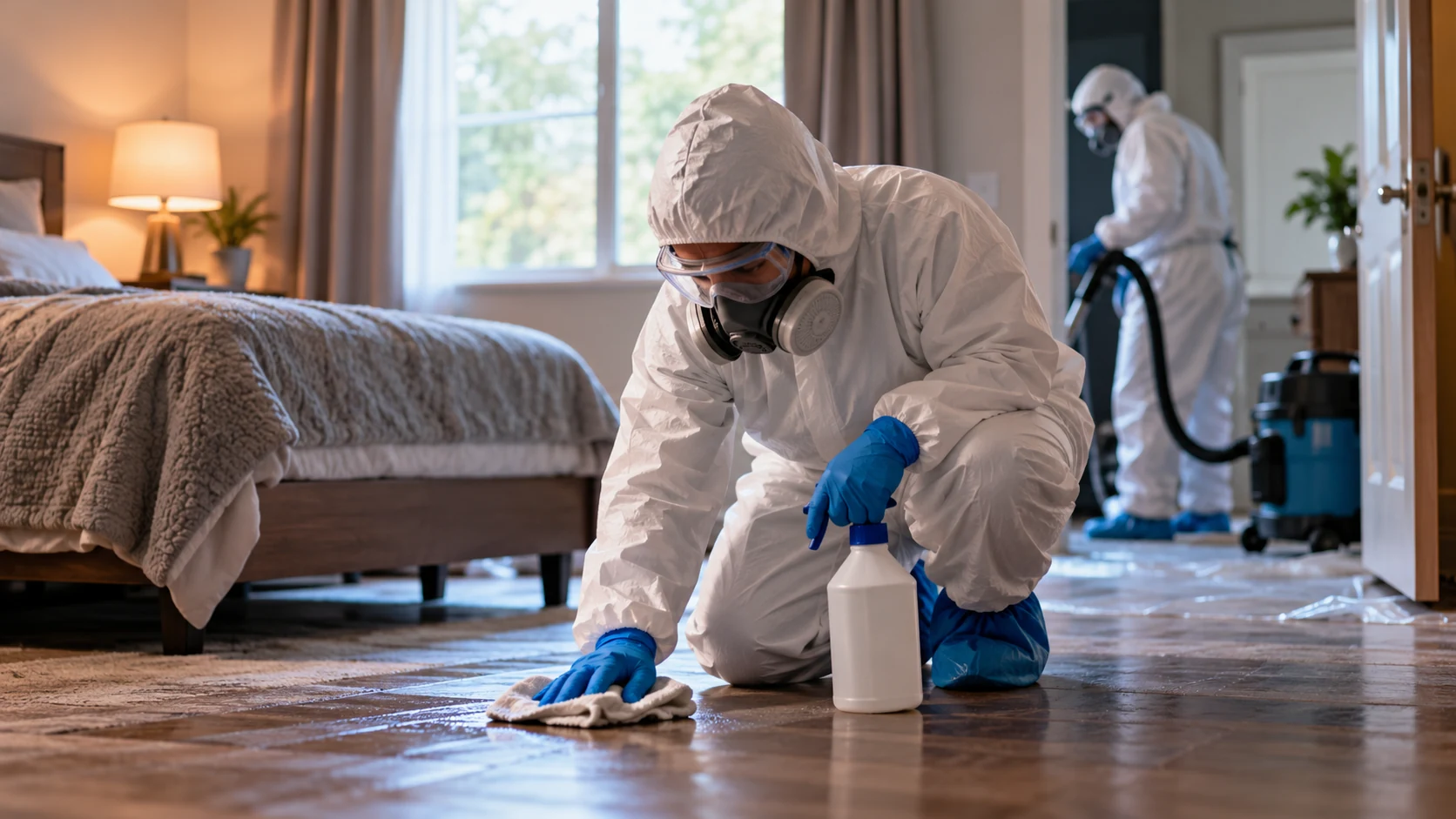
After a death at home, the property owner, the next of kin, or the estate is responsible for cleaning the scene — not the police, the paramedics, the medical examiner, or the funeral home. Those agencies remove the decedent and complete their investigation, then release the property back to the family exactly as it was. When a death leaves behind blood, bodily fluids, or decomposition residue, that cleanup is biohazard work and should be performed by a trained, insured remediation company that follows OSHA bloodborne pathogen protocols and disposes of waste under state medical waste law. Ordinary household cleaning is appropriate only when no biological contamination is present.
Who Is Responsible for Cleaning Up After a Death at Home?
This is the question almost every family asks first, and the answer surprises people during an already devastating week. Responsibility for cleaning the scene of a death falls to whoever owns or controls the property. For a homeowner who dies at home, that is usually the next of kin acting on behalf of the estate. For a rental unit, it is typically the landlord or property manager, though lease terms and state law can shift some of that burden. For a death at a business, care facility, or commercial building, the property owner or operator carries the duty.
No municipal agency in Illinois, or anywhere else in the United States, is tasked with cleaning a private home after a death. Emergency responders stabilize the situation, the medical examiner or coroner determines cause and manner of death, and law enforcement conducts any investigation required. Once those steps are complete and the scene is released, the remaining biological material is a private property matter. Families frequently assume someone official will return to handle it, and that delay allows contamination and odor to spread further into the structure.
| Party Involved | What They Do | Do They Clean? |
|---|---|---|
| Police or Sheriff | Secure the scene and investigate if the death is suspicious | No |
| Paramedics and Fire Department | Attempt life-saving care and confirm death on scene | No |
| Medical Examiner or Coroner | Determine cause and manner of death, transport the decedent | No |
| Funeral Home | Transport and prepare the body for burial or cremation | No |
| Property Owner, Next of Kin, or Estate | Arrange and authorize remediation of the scene | Responsible |
| Licensed Biohazard Remediation Company | Contain, decontaminate, deodorize, and legally dispose of waste | Yes |
Why Police, Coroners, and Funeral Homes Do Not Clean the Scene
Each agency that arrives after a death has a narrow, specific mandate. Law enforcement protects evidence and public safety. The medical examiner is responsible for the decedent, not the dwelling. Funeral directors care for the body and support the family through arrangements. None of these roles includes decontaminating floors, subfloors, mattresses, or wall cavities, and none of these agencies is equipped or funded to do so.
The practical consequence matters: after the decedent is removed, the home is handed back with blood, fluids, or decomposition residue still present. Investigators may also leave behind fingerprint powder, evidence-marking chemicals, or cut flooring. Understanding this in advance spares families the shock of walking back into an untouched room, and it lets them arrange professional help immediately rather than days later, once porous materials have absorbed more contamination.
Ordinary Cleaning vs. Professional Biohazard Cleanup
Not every death at home requires biohazard remediation. When a person passes peacefully, is found quickly, and no bodily fluids were released, the room may only need laundering of bedding, airing out, and normal household cleaning. That situation is genuinely different from one involving blood, purge fluids, or decomposition, where biological material soaks through mattresses, carpet padding, and subfloor seams and cannot be reached with a mop and a spray bottle.
The distinction is not about how dirty a room looks. It is about whether infectious material is present and whether porous building materials have absorbed it. Professional remediation exists because pathogens survive below visible surfaces, because consumer disinfectants are not formulated to neutralize them at household contact times, and because contaminated material is regulated waste that cannot legally go into a curbside bin. For a fuller comparison, see our guide on biohazard cleanup versus regular cleaning.
| Consideration | Ordinary Household Cleaning | Professional Death Cleanup |
|---|---|---|
| Appropriate when | No fluids released and the decedent was found quickly | Blood, bodily fluids, or decomposition are present |
| Protective equipment | Household gloves | Full-body suits, respirators, and eye protection |
| Disinfectants used | Consumer sprays and detergents | EPA-registered hospital-grade virucides with timed wet dwell |
| Porous materials | Washed or surface-treated | Excised and replaced when saturated |
| Odor | Masked with air fresheners | Source removed, then treated with hydroxyl or ozone technology |
| Waste handling | Household trash | Red-bagged regulated medical waste with manifest tracking |
What Are the Health Risks of Cleaning Up After a Death Yourself?
Families often want to handle the cleanup themselves, out of love, privacy, or a sense of duty. It is worth knowing exactly what that involves before deciding. Human blood and bodily fluids can carry bloodborne pathogens including hepatitis B, hepatitis C, and HIV, and hepatitis B in particular can remain infectious on surfaces for days under the right conditions. Decomposition adds bacteria and volatile organic compounds that become airborne and travel well beyond the room where the person was found.
There is also a dimension no protective equipment addresses. Cleaning the place where a parent, spouse, or child died is traumatic in a way that is hard to anticipate, and many people who attempt it describe lasting intrusive memories. Professional technicians are trained to work with discretion and compassion precisely so that families do not have to carry that image.
- Bloodborne pathogens such as hepatitis B, hepatitis C, and HIV can be present in blood and bodily fluids.
- Decomposition releases bacteria and volatile organic compounds that travel through HVAC systems and wall cavities.
- Fluids migrate under flooring and into subfloor seams, where surface cleaning cannot reach them.
- Consumer disinfectants are not formulated to neutralize these pathogens at household contact times.
- Contaminated material is regulated waste and cannot legally be placed in household trash.
- Incomplete cleanup can leave persistent odor and may raise disclosure issues when selling the property.
- The psychological impact of cleaning a loved one’s death scene is significant and long-lasting.
When Should You Hire a Professional Death Cleanup Company?
A simple rule helps: if you can see or smell biological material, or if the death was not discovered immediately, call a licensed biohazard remediation company rather than a janitorial service. Specialized unattended death cleanup crews carry the training, protective equipment, and waste permits this work requires, and they can usually respond the same day.
Timing matters more than most families realize. Biological material continues to penetrate porous surfaces every hour it remains in place, and odor compounds bond to drywall, insulation, and ductwork. A scene addressed within the first day is often far less invasive and less expensive to remediate than the same scene a week later.
- The death was unattended and discovered after hours, days, or longer.
- Blood, bodily fluids, or purge fluids are visible on any surface.
- There is a noticeable odor anywhere in the home.
- Flies, larvae, or other insect activity is present.
- The death involved trauma, a firearm, or a suicide.
- Fluids may have reached carpet, padding, subfloor, mattresses, or upholstery.
- An infectious disease was involved, or children, elderly, or immunocompromised people share the home.
- The property is a rental, estate, or sale property where documented remediation protects you.
How Does the Professional Death Cleanup Process Work?
Professional remediation follows a documented, repeatable protocol designed to eliminate biological hazards without spreading them into clean parts of the home. A trained estimator first assesses the full extent of contamination, often using ultraviolet inspection to reveal fluid migration that is invisible under normal light, because the affected area is almost always larger than what the eye can see.
Technicians then establish containment with sealed polyethylene barriers and negative air pressure, so contaminated air is filtered rather than pushed into adjacent rooms. Gross contamination is removed, saturated porous materials are cut out and packaged as regulated medical waste, and the remaining structure is treated in multiple stages with enzymatic cleaners and EPA-registered hospital-grade disinfectants held for their required wet contact time. Odor is addressed at the source rather than masked, using hydroxyl generators, ozone, or thermal fogging as the situation requires.
The project ends with verification that the space is safe to reoccupy, documentation for insurance, and manifest records proving the waste was legally destroyed. Our detailed walkthrough of what happens during an unattended death cleanup covers each stage in depth.
- Confidential on-site assessment and hazard mapping of the full contamination footprint.
- Containment barriers and HEPA-filtered negative air machines to prevent cross-contamination.
- Removal of gross biological material and excision of saturated carpet, padding, subfloor, and drywall.
- Multi-stage decontamination with enzymatic digestants and hospital-grade virucides.
- Source-level odor remediation rather than fragrance masking.
- Packaging, manifest tracking, and permitted destruction of regulated biohazard waste.
- Final verification, photographic documentation, and insurance paperwork support.
How Much Does Death Cleanup Cost, and Who Pays for It?
Cost depends on how much biological material is present, how far it traveled, how much porous material must be removed, and how many labor hours the scene requires. A small, quickly discovered incident confined to one area sits at the low end. An unattended death with extended decomposition, where flooring, subfloor, and drywall must come out and the HVAC system needs treatment, sits at the high end. Because no two scenes are alike, reputable companies price only after an on-site assessment and put the estimate in writing. Our breakdown of crime scene and trauma cleanup costs in Chicago explains the pricing factors in more detail.
Many families are relieved to learn they are not paying out of pocket. Homeowners and commercial property policies frequently cover biohazard remediation, with the owner responsible only for the deductible, and victims of violent crime may qualify for additional assistance through state compensation programs. Coverage and limits vary by policy, so confirm the details with your carrier early. Our article on whether homeowners insurance covers biohazard cleanup walks through what to ask and what documentation adjusters typically request.
Practical Steps to Take in the First 48 Hours
In the hours after a death at home, a short and clear checklist is more useful than a long one. The priorities are keeping people out of the affected area, protecting the rest of the home from contamination spread, and getting a qualified team on site before conditions worsen.
- Do not enter or clean the affected area, and keep children and pets away from it.
- Close the door to the room and avoid running the HVAC system, which can distribute contaminants and odor.
- Wait for the medical examiner and law enforcement to formally release the scene.
- Call a licensed biohazard remediation company for a confidential assessment, ideally the same day.
- Notify your insurance carrier and ask specifically about biohazard or trauma cleanup coverage.
- Photograph conditions from the doorway only, without entering, for claim documentation.
- Verify that any company you hire is trained in OSHA bloodborne pathogen standards, insured, and permitted for medical waste transport.
- Lean on family, clergy, or a grief counselor. You do not have to manage this alone.
You Do Not Have to Face This Cleanup Alone
Our certified biohazard technicians handle death and unattended death cleanup across Chicago and Cook County with discretion, compassion, and full regulatory compliance. We respond 24/7, provide free written estimates, and work directly with your insurance carrier.
Frequently Asked Questions
Do the police clean up after a death at home?
No. Police secure and investigate the scene, and the medical examiner or coroner handles the decedent, but neither agency cleans the property. Once the scene is released, cleanup becomes the responsibility of the property owner, the next of kin, or the estate, who may hire a licensed biohazard remediation company to perform the work safely.
Can I clean up after a death at home myself?
You may clean your own property, but it is not advisable when blood, bodily fluids, or decomposition are present. Those materials can carry bloodborne pathogens, they penetrate porous surfaces beyond the reach of household cleaners, and contaminated waste cannot be placed in regular trash. Most families also underestimate the emotional toll of cleaning a loved one’s death scene.
Who pays for cleanup after a death in a rental property?
Responsibility usually falls to the landlord or property owner, though lease terms, the circumstances of the death, and state law can shift part of the cost to the tenant’s estate. Landlord insurance often covers biohazard remediation. Document the condition, notify your carrier promptly, and keep written records of the remediation scope and disposal manifests.
How long does professional death cleanup take?
A contained, quickly discovered scene is often completed in a single day. Cases involving extended decomposition, multiple rooms, or removal of flooring and drywall can take two to four days or longer, particularly when odor remediation and structural repairs are required. A technician can give you a realistic timeline after assessing the property.
How soon should I call a death cleanup company?
As soon as the scene has been released by the medical examiner and law enforcement. Biological material continues to penetrate flooring, subfloor, and wall cavities every hour it remains in place, and odor bonds to building materials over time. Calling early typically means less invasive demolition, faster completion, and lower overall cost.