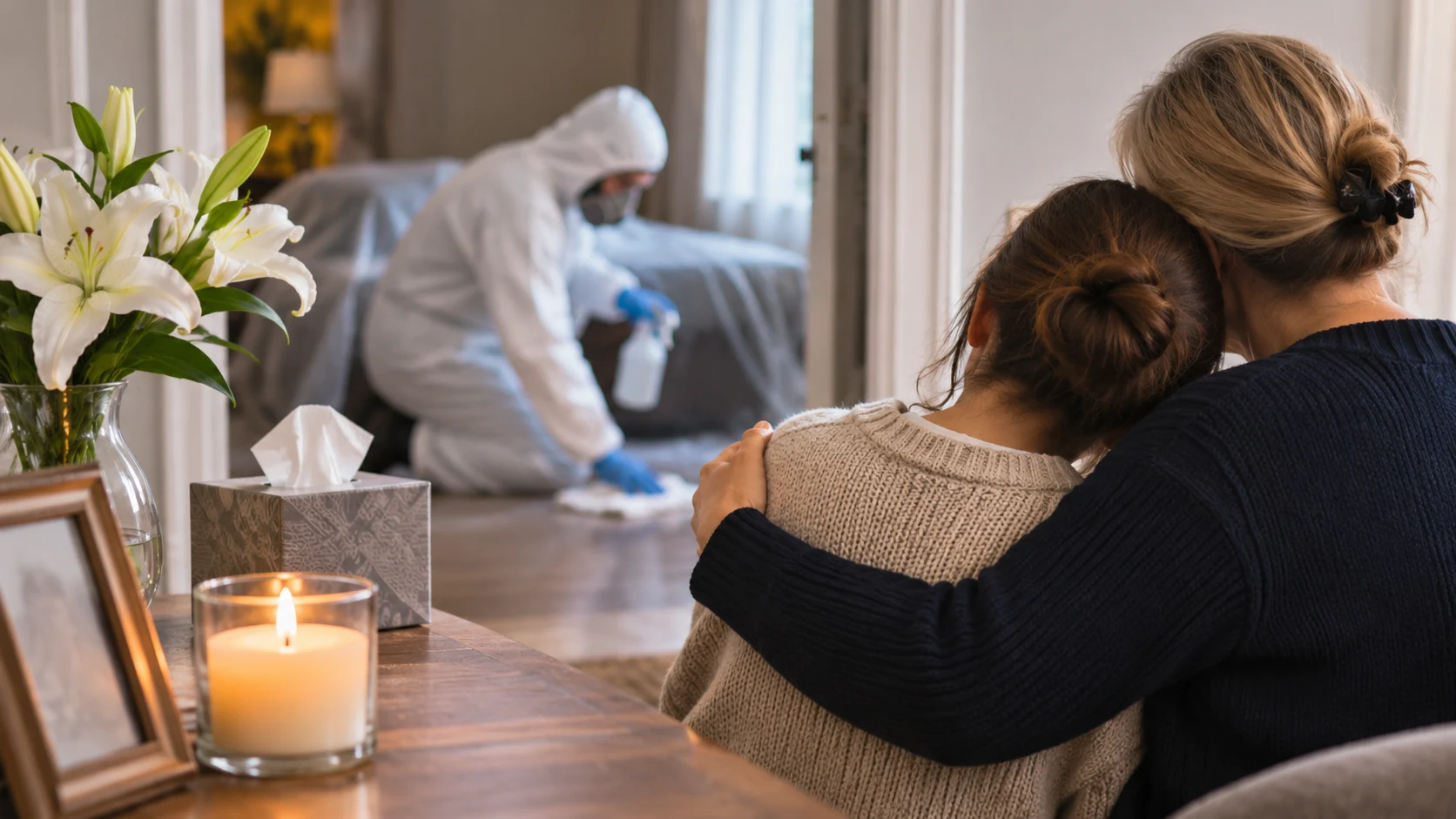
Suicide cleanup is the professional, trauma-informed decontamination of a property after a death by suicide. It is biohazard work rather than cleaning: blood and bodily fluids can carry bloodborne pathogens, they soak into mattresses, carpet padding, subfloor seams, and wall cavities, and the contaminated material is regulated waste under state medical waste law. Responsibility for the cleanup falls to the property owner, the next of kin, or the estate, because police, paramedics, the medical examiner, and the funeral home are not tasked with restoring the room. Families are never obligated to do this work themselves, and most are advised not to. Certified biohazard cleanup technicians handle containment, decontamination, odor treatment, and lawful disposal, and homeowners, landlord, and commercial property insurance frequently covers the cost. If you or someone you love is in crisis, the 988 Suicide and Crisis Lifeline is free and available 24 hours a day by call or text.
First, a Word for the Family Reading This
If you are reading this in the hours or days after losing someone to suicide, we are deeply sorry. There is no correct way to grieve a death like this, and there is no schedule you are failing to keep. Many people arrive at a page like this one not because they want information, but because someone handed them a decision they never asked to make, and they do not know where to begin.
You do not have to understand all of this today. The purpose of this guide is to remove the unknowns, so that one part of an impossible week becomes a single phone call rather than a problem you have to solve alone. Nothing here is meant to rush you, and nothing here asks you to look at anything you would rather not see.
If you or someone close to you is struggling right now, the 988 Suicide and Crisis Lifeline offers free, confidential support at any hour. You can call or text 988 from anywhere in the United States.
What Is Suicide Cleanup?
Suicide cleanup, also called suicide scene cleanup or trauma scene cleanup, is the specialized remediation of a space after a death by suicide. It covers considerably more than the visible area. Trained technicians locate and remove all biological material, decontaminate every affected surface with hospital-grade disinfectants, address odor at its source, and dispose of contaminated materials through permitted medical waste channels.
The reason this is treated as professional biohazard remediation rather than cleaning is straightforward. Blood and bodily fluids travel. They move along floor seams, through carpet padding, into subfloor plywood, behind baseboards, and sometimes into the ceiling of the room below. What is visible on the surface is usually a fraction of what is present, and areas that look untouched can still hold infectious material. Returning a property to a genuinely safe, sanitary condition means finding that full extent and treating all of it.
Professional suicide cleanup services also carry obligations the family does not: following OSHA bloodborne pathogen protocols, documenting the work, and handling regulated waste lawfully from the property through to its final destruction.
- Suicide cleanup is biohazard remediation, governed by federal safety standards and state medical waste law.
- Contamination routinely extends beneath flooring and behind walls, well past what is visible.
- The goal is verified biological safety and a restored room, not a cosmetically clean surface.
- The work is done discreetly, in unmarked vehicles, with no signage and no announcement to neighbors.
Who Is Responsible for Cleaning Up After a Suicide?
Families are often surprised, and sometimes hurt, to learn that no agency returns to handle the scene. Law enforcement secures and investigates. Paramedics provide emergency care. The medical examiner or coroner determines cause and manner of death and takes the decedent into their care. The funeral home attends to the body and supports the family through arrangements. Once the scene is released, the property is handed back as it is, and responsibility for restoring it rests with whoever owns or controls it.
In practice, that usually means the next of kin acting on behalf of the estate, a landlord or property manager when the death occurred in a rental, or the owner or operator in the case of a business or care facility. Knowing this in advance spares families the shock of returning to an untouched room, and it lets them arrange help immediately rather than several days later, once porous materials have absorbed more. Our guide on who cleans up after a death at home covers these roles in more detail.
Being responsible for arranging the cleanup is not the same as being expected to perform it. Authorizing a qualified company fully discharges that responsibility, and for most families it is the kindest decision available to them.
| Who Is Involved | What They Do | Do They Clean the Scene? |
|---|---|---|
| Police or Sheriff | Secure the scene and complete any required investigation | No |
| Paramedics and Fire Department | Provide emergency care and confirm death on scene | No |
| Medical Examiner or Coroner | Determine cause and manner of death, transport the decedent | No |
| Funeral Home | Care for the decedent and guide funeral arrangements | No |
| Family, Property Owner, or Estate | Authorize remediation and coordinate with insurance | Responsible for arranging it |
| Certified Biohazard Cleanup Technicians | Contain, decontaminate, deodorize, restore, and dispose lawfully | Yes |
Why Professional Biohazard Remediation Is Necessary
Some families consider handling the cleanup themselves, often out of love, privacy, or a sense of duty to the person they lost. That instinct deserves an honest answer rather than a sales pitch. There are three reasons this work is left to professionals.
The first is health. Human blood and bodily fluids can carry bloodborne pathogens including hepatitis B, hepatitis C, and HIV, and hepatitis B in particular can remain infectious on surfaces for days under the right conditions. Household gloves and consumer disinfectants are not designed for this exposure, and ordinary cleaning can spread material rather than remove it. Our bloodborne pathogens safety guide explains these risks in plain language.
The second is the building itself. Blood cleanup after a suicide frequently requires removing and replacing saturated flooring, subfloor, drywall, or insulation, because absorbed material cannot be reached by surface treatment. Left in place, it causes persistent odor and ongoing contamination that resurfaces weeks later, sometimes after the room has already been repainted.
The third reason matters most and is discussed least. Cleaning the place where a spouse, parent, child, or sibling died leaves images that are very hard to carry. Many people who attempt it describe intrusive memories long afterward. Certified biohazard cleanup technicians do this work precisely so that families do not have to, and sparing yourself that is a sufficient reason on its own.
- Bloodborne pathogens remain a genuine exposure risk even after visible material is removed.
- Absorbed contamination in porous materials cannot be resolved by surface cleaning.
- Improper handling can worsen odor, spread material, and complicate a later property sale.
- Protecting family members from the scene is a valid and compassionate reason to hire professionals.
The Suicide Cleanup Process, Step by Step
Knowing what will happen in your home can make an overwhelming situation feel more manageable. A professional suicide cleanup follows a defined sequence, and a crew will explain each stage before beginning. You are welcome to be present, to step away entirely, or to name a friend or relative as the point of contact. Many families choose not to be in the home while the work is done, and that is completely normal.
Work cannot begin until law enforcement and the medical examiner have released the scene. From that point, a typical residential project is completed in one to three days, depending on the size of the affected area and how much material must be removed and replaced.
| Stage | What Happens |
|---|---|
| Confidential call and dispatch | A coordinator takes basic details, answers questions, and dispatches a crew, typically within hours |
| On-site assessment | Technicians map the full extent of contamination, including areas beneath and behind visible surfaces |
| Containment | Affected areas are sealed with barriers and placed under negative air pressure with HEPA filtration |
| Biological removal | All biological material and non-salvageable porous materials are removed and sealed for disposal |
| Decontamination | Surfaces are treated with EPA-registered hospital-grade disinfectants at required wet contact times |
| Odor remediation | Odor is treated at the source with hydroxyl or ozone technology rather than masking agents |
| Verification and documentation | Surfaces are tested, results recorded, and photographs and disposal manifests provided |
| Personal belongings | Salvageable items are cleaned and returned to the family; nothing is discarded without permission |
Choosing a Suicide Cleanup Company You Can Trust
Families are rarely in a position to research companies carefully at a moment like this, which is exactly why a short list of the right questions helps. A reputable suicide cleanup company will answer all of them directly, without pressure, and will never ask you to decide on the spot.
Certification and lawful disposal are worth verifying regardless of which company you choose. Technicians should be trained to OSHA bloodborne pathogen standards, the company should carry liability insurance, and contaminated material should be tracked through permitted medical waste channels with documentation handed to you at the end.
- Are your technicians trained and certified to OSHA bloodborne pathogen standards?
- Are you licensed and insured, and can you provide proof of both?
- How is contaminated material disposed of, and will I receive disposal documentation?
- Do you work in unmarked vehicles, and how will my family’s privacy be protected?
- Will you bill my insurance directly and provide the documentation my adjuster needs?
- Is the written estimate free, itemized, and free of any obligation to proceed?
Cost, Insurance, and What Families Usually Pay
Suicide cleanup is priced by scope rather than by a flat fee, because the amount of material to be removed, decontaminated, and lawfully disposed of differs with every scene. Smaller, contained scenes generally fall at the lower end of biohazard pricing, while cases requiring subfloor removal, wall cavity work, or multi-day odor remediation cost more. A dependable figure comes only from an on-site assessment, and any reputable company will provide that estimate in writing, at no cost, before any work begins.
What families most often do not know is that insurance frequently pays. Homeowners, condominium, landlord, and commercial property policies commonly cover trauma and biohazard remediation as direct physical damage to the property, leaving the owner responsible only for the deductible, and coverage is generally not affected by the manner of death. Our guide to homeowners insurance coverage for biohazard cleanup explains which policy sections typically apply and what documentation adjusters ask for.
If cost is a worry, say so when you call. It is a far more common question than people expect, and it should be answered plainly rather than deferred.
Caring for Yourself and Your Family Afterward
Restoring a room is only one part of what follows, and it is the part that can be handed to someone else. Grief after suicide can carry elements that other losses do not, including guilt, anger, and questions that may never have answers. None of that reflects a failure on your part, and none of it means you should be coping better than you are.
Support exists specifically for this. The 988 Suicide and Crisis Lifeline serves both people in crisis and those grieving a suicide loss, by call or text, at any hour. The American Foundation for Suicide Prevention maintains directories of survivor-of-suicide-loss support groups, including groups across the Chicago area, where people who have lived through the same loss meet regularly. Many hospices and funeral homes also offer bereavement counseling that is open to the wider community, not only to their own families.
Some people return to the room once it has been fully restored and find that it helps. Others never want to see it again and choose to sell or leave the property, and that is an equally valid decision. There is no right answer here, and you are allowed to take as long as you need to find yours.
We Are Here Whenever You Are Ready
Our certified trauma scene technicians handle suicide cleanup across Chicago and Cook County with discretion, compassion, and no pressure. Call any hour for a confidential conversation and a free, written, no-obligation estimate. If you or someone you love is in crisis, call or text 988 for immediate support.
Frequently Asked Questions
Who is responsible for suicide cleanup, and will the police clean the scene?
Police, paramedics, the medical examiner, and the funeral home do not clean the scene. Once the investigation is complete and the property is released, responsibility for remediation belongs to the property owner, the next of kin, or the estate. That responsibility means arranging the cleanup, not performing it, and most families authorize a certified biohazard remediation company to carry out the work.
Can a family clean up after a suicide themselves?
No law in Illinois requires a homeowner to hire a professional, but doing it yourself is strongly discouraged. Blood and bodily fluids can carry bloodborne pathogens such as hepatitis B, hepatitis C, and HIV, consumer disinfectants are not formulated to neutralize them, and contaminated porous materials are regulated waste that cannot go into a household bin. Beyond the health risk, cleaning the place where a loved one died often causes lasting psychological harm, which is reason enough to let trained technicians handle it.
How long does suicide cleanup take?
Most residential suicide cleanups are completed within one to three days once law enforcement releases the scene. A small, contained area may be finished in a single day, while scenes requiring subfloor removal, wall cavity work, or multi-day odor remediation take longer. A crew can usually be on site within hours of your call and will give you a realistic timeline after the on-site assessment.
Will neighbors know what happened?
A professional crew arrives in unmarked vehicles with no company signage, no branded uniforms visible from the street, and no discussion of the work with anyone other than the authorized contact. Discretion is a standard part of this service, and you can ask about privacy protections directly when you call. Your family controls what is shared and with whom.
Does homeowners insurance cover suicide cleanup?
Frequently yes. Homeowners, condominium, landlord, and commercial property policies commonly treat biohazard contamination as direct physical damage to the property and cover professional remediation, with the owner responsible only for the deductible. Coverage is generally not affected by the manner of death. Notify your carrier before work begins, and ask the remediation company to supply the photographs, itemized scope, and disposal manifests your adjuster will request.
What happens to belongings and furniture in the room?
Items that can be safely decontaminated are cleaned and returned to the family, and technicians set aside photographs, jewelry, documents, and other irreplaceable belongings whenever possible. Materials saturated with biological fluids, such as mattresses or carpet padding, usually cannot be salvaged and are disposed of as regulated medical waste. Nothing is removed from the home without the family’s permission.