Unattended death cleanup cost typically ranges from $1,500 for a quickly discovered scene to $25,000 or more for severe cases requiring structural removal. Most residential projects land between $3,000 and $10,000. Final pricing is driven by the volume of biological contamination, affected square footage, labor hours, odor remediation, and the regulated disposal of biohazard waste. Homeowners, landlord, and commercial property policies frequently cover decomposition cleanup, leaving the owner responsible only for the deductible. Because no two scenes are alike, a defensible number comes only from an on-site assessment, and our unattended death cleanup team provides free, written, no-obligation estimates before any work begins.
What Is the Average Unattended Death Cleanup Cost?
Unattended death cleanup, sometimes called decomposition cleanup or death scene remediation, is priced as a range rather than a flat fee. Industry sources consistently report that most residential decomposition jobs run between roughly $3,000 and $10,000, with a practical floor near $1,500 for a small scene found within hours and a ceiling of $25,000 or more when a death goes undiscovered for weeks and contamination reaches multiple rooms, the subfloor, or the HVAC system. Unattended deaths sit higher on that scale than most other biohazard work because time is the single most expensive variable, and by definition an unattended death was not found right away.
Many professional crews bill specialized labor at roughly $150 to $600 per hour for a two- to three-technician team, a rate reflecting bloodborne pathogen training, protective equipment, EPA-registered disinfectants, containment and air filtration equipment, and licensed handling of regulated medical waste. A contained scene may be finished in a single day, while advanced decomposition with demolition and multi-day odor treatment can stretch across three to five days. The figures below are general industry ranges published for orientation only. They are not a quote, and the real cost of any project is set after a trained estimator inspects the property.
- The ranges above are general industry figures for orientation, not a price quote.
- Every scene is inspected and priced individually before any work starts.
- We provide free, written, no-obligation estimates across Chicago and Cook County.
| Unattended Death Scenario | Typical Industry Cost Range |
|---|---|
| Found within hours, no fluid release, single contained area | $1,500 to $3,500 |
| Found within 1 to 3 days, limited purge fluids on hard surfaces | $3,000 to $6,000 |
| Found after several days, carpet, padding, and subfloor removal needed | $5,000 to $12,000 |
| Advanced decomposition, multiple rooms, drywall and HVAC affected | $10,000 to $25,000+ |
| Odor remediation only, after biological removal is complete | $500 to $3,000 |
| Specialized labor rate, 2 to 3 technician crew | $150 to $600 per hour |
What Factors Affect Unattended Death Cleanup Pricing?
Two unattended deaths on the same street can differ by ten thousand dollars, and the reason is almost always the condition of the scene rather than the size of the home. The dominant factor is elapsed time. Decomposition releases purge fluids that migrate through carpet, padding, and floor seams into subfloor decking and sometimes into the ceiling below, while volatile compounds such as putrescine and cadaverine bond to drywall, insulation, and ductwork. Each additional day deepens that penetration, turning a surface decontamination into a demolition project.
From there, cost scales with how much material has to leave the building. Labor and regulated disposal are the two largest line items on most invoices, because technicians work in full personal protective equipment under OSHA 29 CFR 1910.1030 protocols and because contaminated porous material is packaged as Potentially Infectious Medical Waste and manifested to a permitted facility. Our breakdown of crime scene and trauma cleanup costs in Chicago covers the same cost mechanics, and our guide to Illinois medical waste disposal laws explains why that disposal carries a real cost.
- Time elapsed before discovery, the strongest single predictor of total cost.
- Volume of purge fluids and the depth of saturation into porous materials.
- Affected square footage and the number of rooms or floors involved.
- Porous materials requiring removal: carpet, padding, subfloor, drywall, mattresses, and upholstery.
- Severity of odor and whether hydroxyl generators, ozone, or thermal fogging are needed.
- Whether the HVAC system, ductwork, or crawlspace became a contamination pathway.
- Total labor hours, crew size, and the volume of regulated waste destroyed under manifest.
- Property access, insect activity, and any structural repairs that follow remediation.
Additional Fees Homeowners Often Do Not Expect
Most of the surprise in a final invoice comes not from the decontamination itself but from the work surrounding it. A written scope should separate biological remediation from the rebuild, because remediation returns a property to a safe, sanitary condition while reconstruction returns it to its original appearance. Replacing the subfloor and flooring that had to be cut out is a legitimate second phase, and it is often handled by a general contractor under a separate line item or contract.
Other common additions include after-hours mobilization, odor treatment requiring equipment on site for several days, content cleaning or disposal of belongings, pest treatment, and confirmation testing. None of these are hidden fees when they appear in the estimate up front. The problem arises when an unusually low initial quote excludes them, so ask directly which items are in scope and which will be billed later.
| Additional Cost Item | Why It Is Billed | Typical Impact |
|---|---|---|
| Emergency or after-hours response | Crew mobilized nights, weekends, or holidays | Premium on labor hours |
| Extended odor remediation | Hydroxyl or ozone equipment left on site for days | Per-day equipment charge |
| Content cleaning or disposal | Furniture, bedding, and belongings treated or discarded | Priced by volume |
| Structural reconstruction | Replacing removed subfloor, flooring, and drywall | Often a separate contract |
| HVAC and duct decontamination | Odor and contaminants spread through the system | Added system scope |
| Regulated waste disposal | PIMW packaging, transport, and permitted destruction | Scales with waste volume |
Does Insurance Cover Unattended Death Cleanup?
In most cases, yes, and this is the detail that changes the financial picture for families. Homeowners policies, landlord and rental dwelling policies, condominium unit-owner policies, and commercial property coverages commonly include biohazard or trauma cleanup, often under dwelling or property protection provisions. When a claim is approved, the property owner is typically responsible only for the deductible, frequently $500 to $2,500, and the carrier pays the remainder.
Coverage is not automatic. Some policies cap the amount available for biohazard remediation, some require a licensed and insured contractor, and some depend on an endorsement being in place. Carriers also expect documentation: photographs, an itemized scope of work, contamination mapping, and disposal manifests. Notify your insurer before work begins, ask specifically about biohazard and trauma cleanup limits, and keep every record. Our guide to whether homeowners insurance covers biohazard cleanup explains what to ask an adjuster and the paperwork that keeps a claim moving.
Who Pays If There Is No Insurance Coverage?
When no policy applies, responsibility for the cost follows responsibility for the property. For a homeowner who died at home, the estate or next of kin usually arranges and pays for remediation, and estate funds may be used as a cost of settling the estate. In a rental, the landlord or property owner typically carries the duty, although lease terms and the circumstances of the death can shift part of the expense to the tenant’s estate. Our article on who cleans up after a death at home sets out these roles in more detail.
If the death involved violent crime, the Illinois Crime Victims Compensation Program, administered by the Illinois Attorney General’s office under the Crime Victims Compensation Act, may reimburse eligible applicants for certain cleanup expenses. Award limits, covered expenses, and filing deadlines change over time, so confirm current terms with that office directly.
What Does the Price Actually Include?
A professional estimate pays for a documented remediation protocol, not for cleaning. The scope begins with a confidential assessment that maps the full contamination footprint, often using ultraviolet inspection to reveal fluid migration invisible in normal light, because the affected area is nearly always larger than it appears. The work then proceeds through containment, removal, decontamination, odor treatment, and verified clearance, with each stage adding labor, consumables, and equipment time. Our walkthrough of what happens during an unattended death cleanup shows how these phases fit together on a real project.
- On-site hazard assessment, contamination mapping, and a written scope of work.
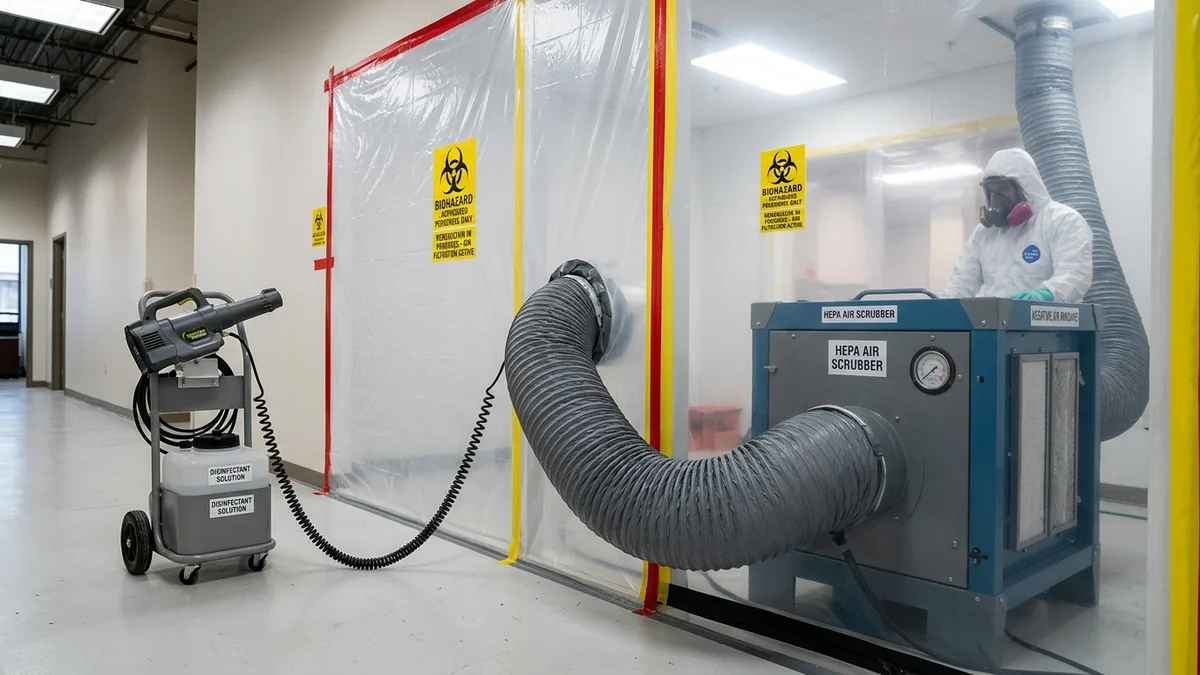
- Sealed containment and HEPA-filtered negative air machines to prevent cross-contamination.
- Removal of gross biological material and excision of saturated carpet, padding, subfloor, and drywall.
- Multi-stage decontamination with enzymatic digestants and hospital-grade virucides at full wet dwell time.
- Source-level odor remediation with hydroxyl generators, ozone, or thermal fogging rather than masking agents.
- PIMW packaging, chain-of-custody manifests, and permitted destruction of all regulated waste.
- Confirmation testing, photographic records, and claim-ready documentation for your adjuster.
- Discreet unmarked vehicles and crews, which matters in dense neighborhoods and multi-unit buildings.
How to Compare Unattended Death Cleanup Quotes
The lowest number on the page is not always the lowest final cost. Because this work is priced by scope, the only fair comparison is between estimates covering identical work. Ask each company to itemize the scope, state what is excluded, and confirm in writing that disposal, odor treatment, and documentation are included. Then verify credentials, because an underqualified crew that leaves pathogens in the subfloor or odor in the drywall creates a second project at full price, and incomplete remediation can resurface as a disclosure problem when the property is sold.
- Insist on a written, itemized estimate that lists exclusions as clearly as inclusions.
- Confirm whether structural reconstruction is included or contracted separately.
- Ask how odor remediation is priced and how many days equipment stays on site.
- Verify OSHA bloodborne pathogen training, liability insurance, and medical waste transport permits.
- Require disposal manifests and a final verification report as deliverables.
- Treat any quote given over the phone without an assessment as an estimate, not a price.
Get an Accurate Unattended Death Cleanup Quote
Pricing depends entirely on the condition of the scene, so get a free, confidential, no-obligation written estimate from our certified remediation team. We respond 24/7 across Chicago and Cook County, work discreetly in unmarked vehicles, and document your insurance claim from start to finish.
Frequently Asked Questions
How much does unattended death cleanup cost on average?
Most residential unattended death cleanups fall between roughly $3,000 and $10,000, with small, quickly discovered scenes starting near $1,500 and severe decomposition cases involving multiple rooms, subfloor removal, and HVAC decontamination reaching $25,000 or more. These are general industry ranges rather than quotes, since the final price depends on contamination volume, affected materials, labor hours, and regulated disposal measured during an on-site assessment.
Why does unattended death cleanup cost more than other biohazard cleanup?
Because time works against the property. Decomposition releases fluids that soak through flooring into subfloor and sometimes the ceiling below, while odor compounds bond to drywall, insulation, and ductwork. That usually means demolition rather than surface decontamination, plus multi-day odor remediation and a larger volume of regulated medical waste, all of which add labor and disposal cost that a quickly discovered scene avoids.
Will homeowners insurance pay for unattended death cleanup?
Frequently yes. Many homeowners, landlord, condominium, and commercial property policies cover biohazard and trauma remediation, with the owner responsible only for the deductible. Limits, endorsements, and contractor requirements vary by policy, so notify your carrier before work begins and ask specifically about biohazard cleanup coverage. A qualified remediation company will supply the photographs, itemized scope, and disposal manifests adjusters request.
Does the cost include replacing the flooring and drywall that were removed?
Usually not. Remediation returns the property to a safe, sanitary condition, which includes cutting out and legally disposing of saturated materials. Rebuilding the subfloor, flooring, and drywall is reconstruction, commonly quoted as a separate phase or handled by a general contractor. Ask for both figures up front so you understand the full cost of returning the property to its original condition.
Can I reduce the cost of unattended death cleanup?
The most effective step is calling immediately once the medical examiner and law enforcement release the scene, because contamination and odor spread further every hour. Keep the affected door closed, avoid running the HVAC system, do not attempt cleaning yourself, and file an insurance claim promptly. Obtaining more than one itemized written estimate also helps, provided each covers an identical scope of work.