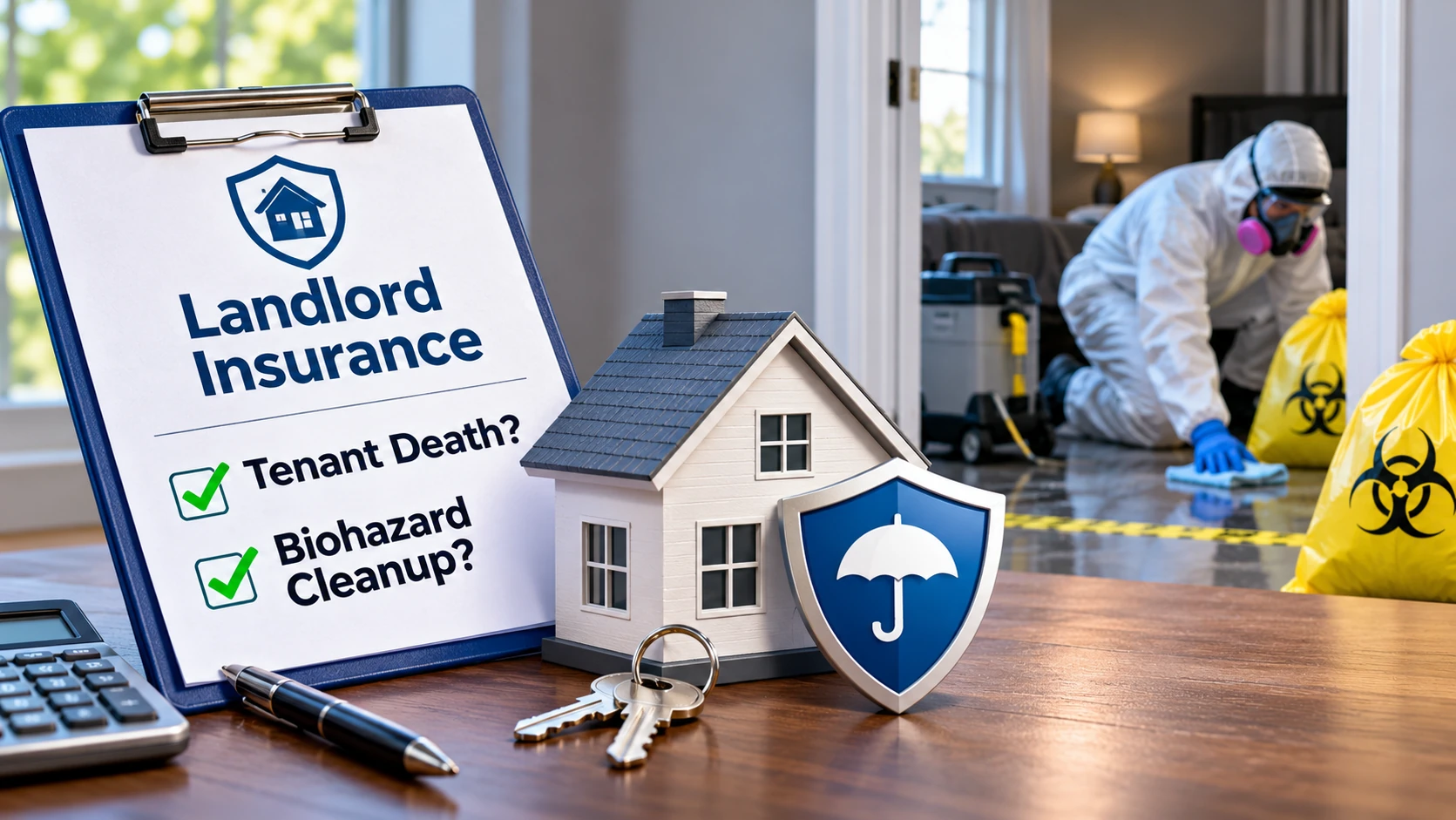
In most cases, yes. Landlord insurance — a dwelling fire policy such as a DP-3, an apartment package, or a commercial property policy — generally treats biological contamination from a tenant death as sudden, accidental direct physical damage to the building, which places professional biohazard remediation under the policy’s property damage coverage. The owner is typically responsible only for the deductible. Many landlord policies also include Fair Rental Value coverage, which can reimburse rent lost while the unit cannot be occupied during decontamination. What landlord insurance usually does not cover is the deceased tenant’s personal belongings, damage a carrier can attribute to gradual neglect, or remediation carried out with no documentation an adjuster can verify.
Does Landlord Insurance Cover Tenant Death Cleanup?
Landlord insurance usually covers tenant death cleanup, because carriers classify the contamination rather than the event. Blood, bodily fluids, and decomposition byproducts that soak into flooring, subfloor, drywall, and framing are direct physical damage to covered property, and the cost of removing that damage is a property loss like smoke or water damage. The manner of death — natural causes, accident, suicide, or homicide — is generally not what determines coverage.
This is the same principle that applies when an owner-occupant dies at home, which our guide on homeowners insurance coverage for biohazard cleanup covers in detail. The difference for a landlord is structural rather than conceptual: a rental policy is built around a building you own but do not live in, so it adds rent protection, excludes the occupant’s possessions, and is far more sensitive to how quickly you report and document the loss.
Coverage is never automatic, though. Landlord policy forms vary widely between carriers, and a basic named-peril dwelling form protects far less than an open-peril DP-3 or a commercial property form. Before assuming the claim is covered, read the declarations page for the form number, the deductible, and whether Fair Rental Value and Ordinance or Law coverage are included. If anything is unclear, ask the carrier for a coverage position in writing.
Which Parts of a Landlord Policy Pay for Rental Property Biohazard Cleanup?
Rental property biohazard cleanup rarely falls under a single line of a policy. A tenant death claim usually draws on several coverage parts at once, because the loss involves the structure, the owner’s contents, the disposal of regulated material, and the period when the unit produces no income.
Knowing which part funds which portion of the work matters when an adjuster questions a line item. A remediation scope that is priced as one lump sum is easy to dispute; the same scope broken out by coverage part is much harder to reduce.
- The deceased tenant’s personal property is not covered by the landlord policy; that belongs to renters insurance or the estate.
- Fair Rental Value typically reimburses lost rent only for the period the unit genuinely cannot be occupied.
- Stigma and any perceived loss of market value are not insured damage under a standard property form.
- Deductibles apply per occurrence, so a single tenant death claim carries one deductible across all affected coverage parts.
| Policy Section | What It Typically Funds After a Tenant Death |
|---|---|
| Dwelling or Building | Removal of contaminated subfloor, drywall, and insulation, structural disinfection, sealing, and rebuild of the affected area |
| Other Structures | Decontamination of a detached garage, coach house, or outbuilding where contamination actually occurred |
| Landlord’s Contents | Owner-supplied carpet, appliances, window treatments, and furnishings in a furnished or short-term rental |
| Debris Removal | Lawful packaging, transport, and destruction of regulated biological waste generated by the remediation |
| Fair Rental Value | Rent lost while the unit is uninhabitable during remediation, less expenses that do not continue |
| Ordinance or Law | Code-required upgrades triggered when repairs open up an older building, when the coverage is carried |
What Does Landlord Insurance Coverage for Decomposition Actually Have to Pay For?
Unattended deaths produce the largest claims, and landlords are routinely surprised by the scope. Decomposition releases fluids and volatile compounds that move downward and outward: through floor seams into subfloor plywood, along joists, into the ceiling of the unit below, and into shared HVAC returns that distribute odor through an entire building. A scene that looks confined to one bedroom can involve two units and a common corridor.
That is why landlord insurance coverage for decomposition has to extend well past surface cleaning. A defensible remediation scope typically includes containment and negative air filtration, removal of saturated porous materials, enzymatic treatment and EPA-registered hospital-grade disinfection of structural surfaces, source-level odor remediation rather than masking, verification testing, and documented disposal. Our walkthrough of what happens during unattended death cleanup explains each stage in order.
Biohazard remediation costs scale with that scope rather than with square footage, so a written on-site assessment is what turns an estimate into something an adjuster can approve. We break down the variables that drive the number in our guide to unattended death cleanup cost.
When Is an Unattended Death Cleanup Insurance Claim Denied or Reduced?
Most unattended death cleanup insurance disputes are not about whether contamination is covered. They are about the owner’s conduct after the loss was discovered, and almost all of them are avoidable.
Carriers reduce or deny claims when the record suggests the damage was allowed to worsen, when the evidence of the original condition was destroyed before anyone documented it, or when the policy form simply did not include the coverage the owner assumed was there. Every one of these is easier to prevent in the first twenty-four hours than to argue three weeks later.
- Delay: property policies impose a duty to mitigate, and contamination that spreads during an avoidable delay may be excluded as neglect.
- Undocumented self-help: sending staff to strip carpet before photographs are taken destroys the proof the adjuster needs.
- Wrong form: a basic named-peril dwelling policy may not respond at all, where an open-peril form would.
- Vacancy conditions: many property forms restrict coverage once a building has stood vacant beyond a stated period.
- Late notice: carriers require prompt reporting, and prompt means as soon as the loss is discovered, not after remediation ends.
- No verification: without testing records and disposal manifests, an adjuster has no basis to confirm the work performed.
How Should a Landlord Document a Tenant Death Property Damage Claim?
Documentation is the whole claim. A tenant death property damage file that an adjuster can approve without a site visit moves faster than one that requires an inspection, and it is built in a specific order.
Begin only after law enforcement and the medical examiner release the property; nothing should be moved or cleaned before that point. Then report the loss to your carrier, retain a biohazard remediation firm experienced in insurance work, and let that firm document the condition before any demolition begins. Reputable firms bill the carrier directly under a third-party billing agreement and prepare scopes using the estimating standards adjusters already work with, which removes most of the friction from the process.
If the property is managed rather than owner-operated, make one person the point of contact for the carrier. Split communication between an owner, a manager, and an on-site staff member is a common reason a claim stalls.
- Report the loss to the carrier as soon as the scene is released, and record the claim number and adjuster contact.
- Have the remediation firm photograph and map the full extent of contamination before any material is removed.
- Keep an itemized scope of work separating structural remediation, owner contents, disposal, and reconstruction.
- Retain disposal manifests and verification test results; they substantiate the work after the evidence is gone.
- Track the dates the unit was unrentable to support a Fair Rental Value claim.
- Document the pre-loss condition from move-in inspections and prior maintenance records where available.
Can a Landlord Bill the Tenant’s Estate or Use the Security Deposit?
This is the most common follow-up question landlords ask, and it deserves a careful answer rather than a confident one. In general, a lease does not automatically end when a tenant dies, and obligations under it may pass to the estate — but how that interacts with biohazard remediation costs, security deposit deductions, and the probate process depends on the lease, on Illinois law, and in Chicago on the Residential Landlord and Tenant Ordinance. Deposit handling in particular is governed by statute and local ordinance, with specific notice and itemization requirements. These are questions for an Illinois real estate attorney, not for a remediation company.
What is reliably true is a matter of scale. Remediation after an unattended death routinely exceeds a security deposit by a wide margin, and pursuing a grieving family or an estate through probate is slow, uncertain, and rarely recovers the full cost. Insurance is the practical route, and it is the one carriers expect landlords to use.
Whether a death must be disclosed to prospective tenants or buyers is a separate legal question with its own rules, and it is worth raising with the same attorney. The part a landlord controls is the condition of the unit: thorough, verified, documented remediation is what makes the property genuinely safe to re-rent.
Why Landlords Should Not Assign Maintenance Staff to Clean a Tenant Death
Directing an employee to clean blood or decomposition residue is not only a health risk; for a landlord with staff it is a regulatory one. Under the federal OSHA Bloodborne Pathogens Standard (29 CFR 1910.1030), an employer whose workers have reasonably anticipated occupational exposure to blood or other potentially infectious materials must maintain a written exposure control plan, provide training and appropriate personal protective equipment, and make hepatitis B vaccination available. A maintenance technician handed gloves and a mop is covered by none of that. Our bloodborne pathogens safety guide explains the exposure risks in plain language.
Disposal is regulated separately. Materials saturated with blood or bodily fluids are not ordinary building debris, and in Illinois their handling falls under the state’s potentially infectious medical waste rules, which require proper packaging and tracked transport to a permitted treatment facility — the subject of our guide to Illinois medical waste disposal laws. A dumpster behind the building is not a lawful destination.
There is a claims dimension too. Work performed by untrained staff, with no containment, no verification testing, and no manifests, gives an adjuster little to approve and can leave the owner funding the professional remediation that follows anyway. Professional unattended death cleanup protects the building, the staff, the next tenant, and the claim at the same time. For a fuller picture of where each party’s responsibility begins and ends, see our guide on who cleans up after a death at home.
Managing a Tenant Death in a Chicago Rental Property?
Our certified technicians handle unattended death and biohazard remediation for landlords, property managers, and building owners across Chicago and Cook County, working directly with insurance carriers and supplying the photographs, itemized scope, verification results, and disposal manifests adjusters ask for. Call any hour for a confidential conversation and a written assessment.
Frequently Asked Questions
Does landlord insurance cover biohazard cleanup if the tenant died of natural causes?
Usually yes. Property carriers evaluate the contamination as direct physical damage to the building rather than evaluating the manner of death, so natural causes, accident, suicide, and homicide are generally treated the same way under the property damage provisions. Coverage still depends on the policy form, the deductible, and prompt reporting, so confirm the position with your carrier in writing before work begins.
Will landlord insurance pay for the lost rent while the unit is being decontaminated?
Many landlord policies include Fair Rental Value coverage, which reimburses rental income lost while the unit cannot be occupied because of a covered loss, less expenses that do not continue during that period. It applies only for the time the unit is genuinely uninhabitable, so keep dated records of when remediation started and finished and when the unit was returned to the market. Check the declarations page, since not every form carries this coverage.
Who pays for the deceased tenant’s damaged belongings?
A landlord policy covers the building and the owner’s property, not the tenant’s. Contaminated furniture, mattresses, clothing, and personal effects belonging to the tenant fall to the tenant’s renters insurance, if any was in force, or to the estate. Landlords should not dispose of a deceased tenant’s property on their own judgment; coordinate with the estate representative, and ask an attorney about the correct handling before anything is removed.
Should a landlord file the claim before or after hiring a remediation company?
Do both quickly, and in that order where possible. Report the loss to the carrier as soon as the scene is released so the claim is opened and the duty to mitigate is documented, then bring in a biohazard remediation firm that works directly with insurers. The firm documents the condition before demolition, which is the evidence the adjuster relies on later. What should not happen is remediation, or any cleaning by staff, before the condition is recorded.
Does filing an unattended death cleanup claim affect a landlord’s future premiums?
That depends on the carrier, the policy, and the owner’s claims history. A tenant death is a sudden, non-preventable loss rather than a maintenance failure, which carriers underwrite differently from recurring claims such as repeated water damage. The carrier or an independent agent can give a specific answer for a specific policy; a remediation company cannot.
What if the rental property has no insurance coverage for biohazard remediation?
Remediation is still necessary, because the contamination does not resolve on its own and the unit cannot lawfully or safely be re-rented in that condition. Ask for a written, itemized scope so you can see exactly what the work involves, and discuss the sequencing of the project. When a violent crime is involved, the Illinois Crime Victims Compensation Act may provide assistance to eligible victims and immediate family members, though it is directed at victims rather than at property owners.